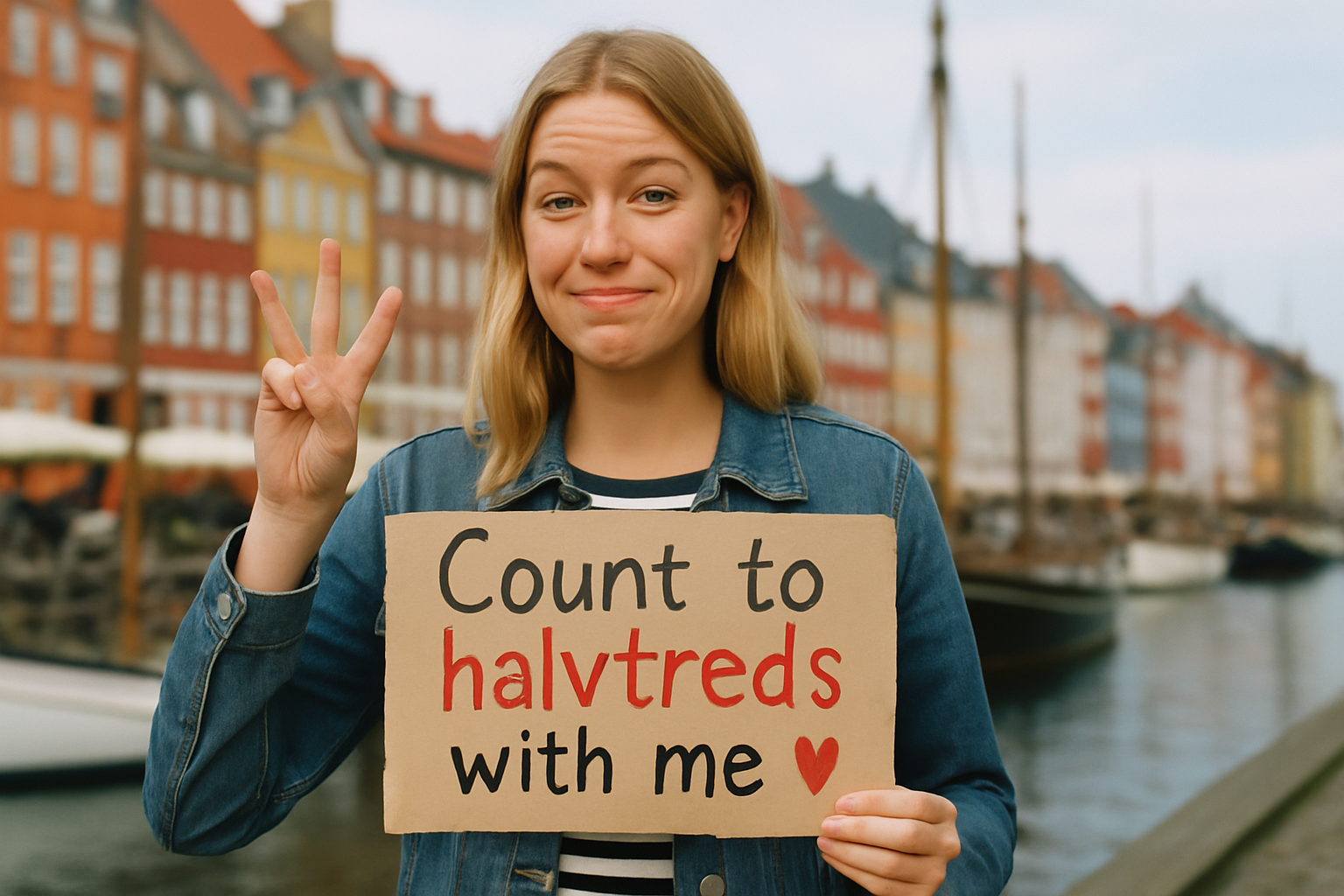
Danish has the most unusual counting system in modern Europe. Above 50, the names are based on twenties — and they include fractions like halvtreds ("half-three" twenties = 2.5 × 20 = 50). It sounds insane until you see the math, then it becomes one of the most fascinating fossils in any living language. By the end of this page, you'll decode every Danish number — including the legendary 50, 70, and 90.
What you'll walk away with
- Hear every Danish number from a native Copenhagen voice
- Decode the famous vigesimal (base-20) tens — halvtreds, tres, halvfjerds, firs, halvfems
- Walk away able to read kroner prices, phone numbers, and years
The foundational ten — 0 to 10 in Danish
These eleven words are the building blocks for every Danish number you'll ever say. Tap any to hear it spoken. Spend a minute here — the rest of the article assumes you've heard each of them.
- 0 — nul
- 1 — en
- 2 — to
- 3 — tre
- 4 — fire
- 5 — fem
- 6 — seks
- 7 — syv
- 8 — otte
- 9 — ni
- 10 — ti
11 to 20 — where Danish shows its character
Some of these are unique words you'll need to memorize; others follow a pattern. Tap any to hear it. Pay attention to the rhythm — the teens often have a distinctive cadence in each language.
- 11 — elleve
- 12 — tolv
- 13 — tretten
- 14 — fjorten
- 15 — femten
- 16 — seksten
- 17 — sytten
- 18 — atten
- 19 — nitten
- 20 — tyve
The tens — 20, 30, 40… up to 100
Once you know these, you can build every two-digit number using the combining rule below. Tap any to hear it.
- 20 — tyve
- 30 — tredive
- 40 — fyrre
- 50 — halvtreds (half-third × 20 = 2.5 × 20)
- 60 — tres (3 × 20)
- 70 — halvfjerds (half-fourth × 20 = 3.5 × 20)
- 80 — firs (4 × 20)
- 90 — halvfems (half-fifth × 20 = 4.5 × 20)
- 100 — hundrede
The vigesimal Danish system (or, why Danes count in twenties)
Above 40, Danish is vigesimal — built on multiples of 20 instead of 10. Tres (60) is tre × 20. Firs (80) is fire × 20. The halv- prefix doesn't mean half — it means "half-toward-the-next". Halvtreds (50) = halv-tredje ("half-third") sinde tyve = 2.5 × 20 = 50. Halvfjerds (70) = 3.5 × 20. Halvfems (90) = 4.5 × 20. For two-digit numbers above 20, the unit comes first, then og (and), then the tens — backwards like German. Enogtyve (21), femoghalvtreds (55), niogfems (99).
Big numbers — 100, 1,000, and 1,000,000
These three words unlock everything from prices to populations to budgets. Tap any to hear it.
- 100 — hundrede
- 1000 — tusind
- 1000000 — million
How to think about Danish numbers without going mad
Six insights that make the vigesimal system click.
- The big idea: above 40, count by 20s, not 10s. Once you see tres = three twenties, the rest follows. Danish kept this from Old Norse while every other Germanic language went decimal.
- *The halv- numbers (50, 70, 90) are "half toward the next twenty". Halvtreds* literally means "half-third [twenty]" — meaning halfway from the second twenty to the third. So 2.5 × 20 = 50. The same logic gives 70 and 90.
- Above 20, the unit comes first. Tooghalvtreds (52) = "two and fifty". This is the same backwards rule as German and Dutch.
- Banks and contracts use a different system. Old-school Danish business uses femti (50), seksti (60), halvfjerds — readable Norwegian-style numbers — for clarity in finance. You'll see this on official forms.
- Hundreds and thousands behave normally. Hundrede (100), tusind (1000), million (1M). The vigesimal madness only affects the 50–99 range.
- Phone numbers in Denmark are read in pairs. 12 34 56 78 reads as tolv, fireogtredive, seksoghalvtreds, otteoghalvfjerds. Each pair is a number on its own.
Why Danish counting is harder than it looks (and worth the effort)
Danish numbers are objectively the hardest in any major European language. Above 40, you're counting in twenties and applying half-toward-the-next math. Yes, really. But the system is fully regular within itself — once you accept the vigesimal rule and learn five irregular tens (halvtreds, tres, halvfjerds, firs, halvfems), you can produce every two-digit Danish number. That moment when halvfems stops feeling like a riddle is one of the most rewarding in all of language learning.
Ready to count in real conversations?
Numbers are everywhere — in prices, in addresses, in dates, in directions. Lingden teaches Danish through real sentences with native audio and IPA on every word, so the numbers you just learned become the words people actually use. Free forever for one language. No card required.