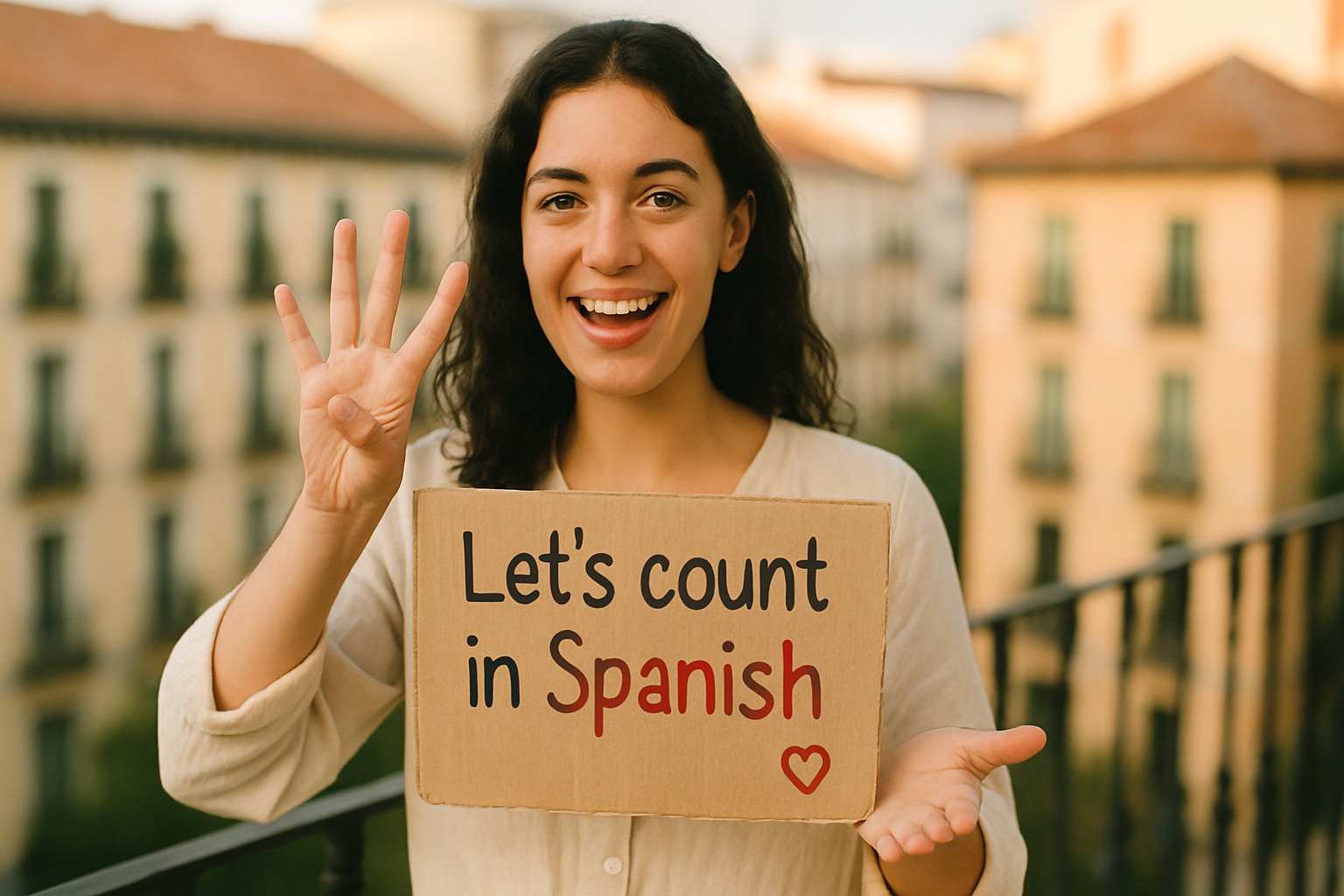
Spanish numbers are one of the friendliest systems in any major language. The first ten are easy, the teens fall into a rhythm, and once you know how to combine the tens with the units, you can count to a million without learning anything new. By the end of this page, you'll be able to say any number — your phone number, your age, the time, prices in pesos — and have a real shot at sounding right.
What you'll walk away with
- Hear every number from zero to a million in a native Spanish voice
- Learn the one combining rule that builds 90% of all the numbers you'll ever say
- Know the three quirky hundred-words (500, 700, 900) that catch every learner off-guard
The foundational ten — 0 to 10 in Spanish
These eleven words are the building blocks for every Spanish number you'll ever say. Tap any to hear it spoken. Spend a minute here — the rest of the article assumes you've heard each of them.
- 0 — cero
- 1 — uno
- 2 — dos
- 3 — tres
- 4 — cuatro
- 5 — cinco
- 6 — seis
- 7 — siete
- 8 — ocho
- 9 — nueve
- 10 — diez
11 to 20 — where Spanish shows its character
Some of these are unique words you'll need to memorize; others follow a pattern. Tap any to hear it. Pay attention to the rhythm — the teens often have a distinctive cadence in each language.
- 11 — once
- 12 — doce
- 13 — trece
- 14 — catorce
- 15 — quince
- 16 — dieciséis
- 17 — diecisiete
- 18 — dieciocho
- 19 — diecinueve
- 20 — veinte
The tens — 20, 30, 40… up to 100
Once you know these, you can build every two-digit number using the combining rule below. Tap any to hear it.
- 20 — veinte
- 30 — treinta
- 40 — cuarenta
- 50 — cincuenta
- 60 — sesenta
- 70 — setenta
- 80 — ochenta
- 90 — noventa
- 100 — cien
How to build any Spanish number
The combining rule is simple: for 21–29, the tens and units fuse into a single word — veintiuno, veintidós, veintitrés. From 31 onward, you say the tens word, then "y" (and), then the units word: treinta y uno, cuarenta y dos, noventa y nueve. That's it. Hundreds work the same way: ciento uno (101), ciento veintitrés (123). For 200–900, you'll combine numbers like doscientos, trescientos — most are predictable, except for three sneaky ones (see below).
Big numbers — 100, 1,000, and 1,000,000
These three words unlock everything from prices to populations to budgets. Tap any to hear it.
- 100 — cien
- 1000 — mil
- 1000000 — millón
The Spanish number quirks every learner trips on
Six things that take Spanish counting from textbook-correct to actually-Spanish.
- *The number uno changes form. Before a masculine noun it drops to un (un libro), before a feminine noun it becomes una (una mesa). Same for compound numbers ending in 1: veintiún libros, veintiuna mesas*.
- The 100 word is two words. Cien exactly when alone or before a thousand (cien mil). Ciento in compounds: ciento uno, ciento dos. Cien and ciento are the same word; the apocopation is the rule.
- Three hundreds are irregular. 500 is quinientos (not cincocientos), 700 is setecientos (not sietecientos), 900 is novecientos (not nuevecientos). Memorize these three; the others (200, 300, 400, 600, 800) follow the pattern.
- Hundreds agree with gender. Doscientos hombres but doscientas mujeres. The masculine -os changes to feminine -as.
- Punctuation flips. Spanish uses a period as the thousands separator and a comma for decimals. €1.234,56 reads as one thousand two hundred thirty-four euros and fifty-six cents.
- Years are read as full numbers, not in pairs like English. 1985 is mil novecientos ochenta y cinco — "one thousand nine hundred eighty-five".
Why Spanish counting unlocks faster than almost any major language
Spanish counts the way it spells: phonetic, predictable, and kind to learners. Master the foundational 30 words and one combining rule, and you can say any number from zero to a million. The system is more rigorous than English (no "twenty-one" / "twenty-two" inconsistency) and more compact than French. It rewards a single afternoon of effort with a lifetime of usable arithmetic.
Ready to count in real conversations?
Numbers are everywhere — in prices, in addresses, in dates, in directions. Lingden teaches Spanish through real sentences with native audio and IPA on every word, so the numbers you just learned become the words people actually use. Free forever for one language. No card required.