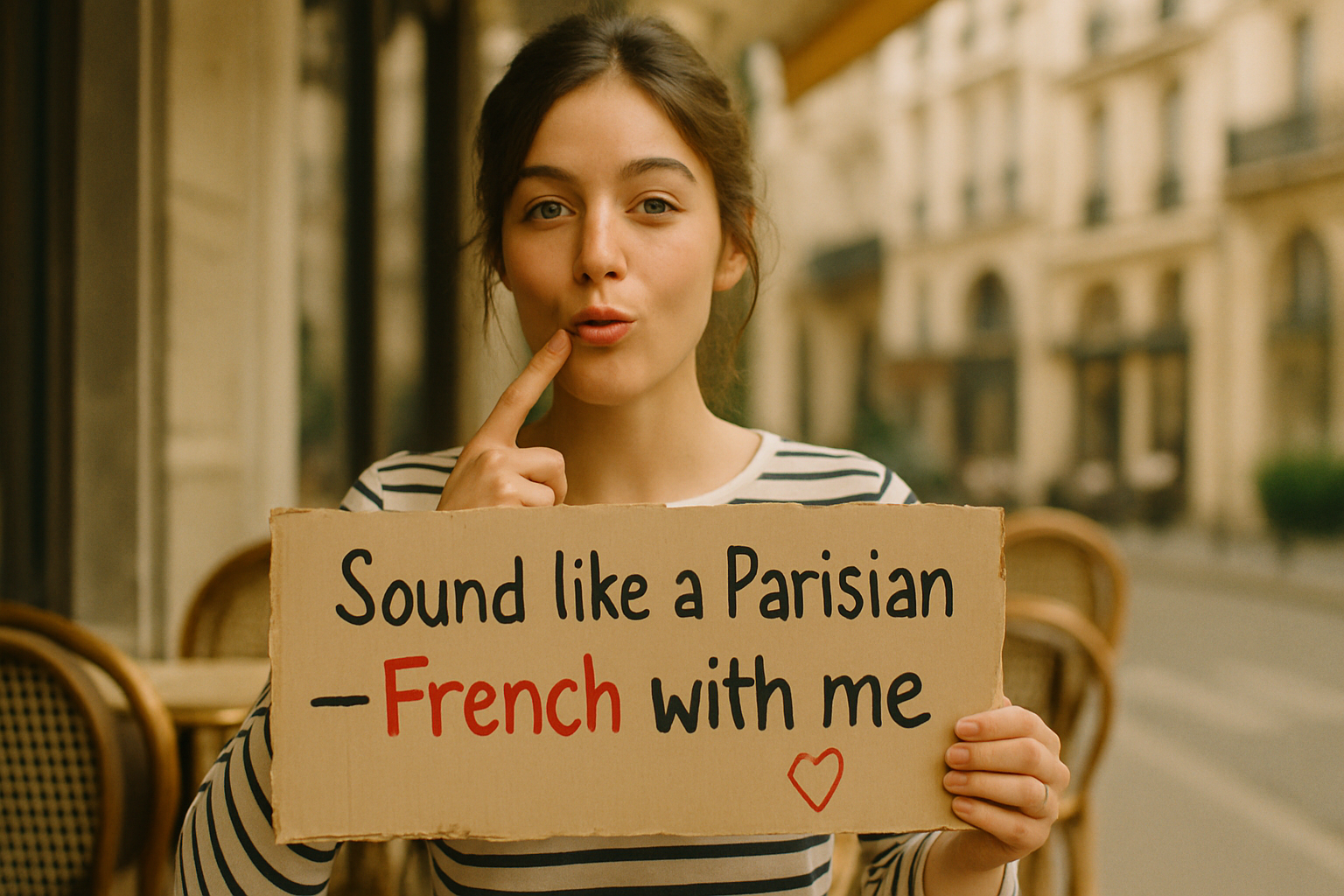
French has a reputation for being hard to pronounce. The truth is more interesting: French isn't hard, it's unforgiving of guessing. Skip the rules and you'll mangle every sentence. Learn them — and you'll discover French actually reads more predictably than English. By the end of this page, you'll know every letter of the French alphabet by sound, and you'll understand exactly why French looks the way it does.
What you'll walk away with
- Hear every letter of the French alphabet from a Parisian voice
- Crack the silent-letter code that makes French look harder than it is
- Lock in the rounded u, the throaty r, and the nasal vowels that define the language
The French alphabet, one tap at a time
Every letter is tap-to-hear. The first form is the letter; the italic name is what you say when reciting the alphabet — that's what plays when you tap. Example words are tap-to-hear in native French.
- A a — /a/ — ami (friend)
- B bé — /b/ — bonjour (hello)
- C cé — /k / s/ — café (coffee)
- D dé — /d/ — demain (tomorrow)
- E e — /ə / e / ɛ/ — école (school)
- F effe — /f/ — fleur (flower)
- G gé — /ɡ / ʒ/ — gâteau (cake)
- H ache — (silent) — hôtel (hotel)
- I i — /i/ — île (island)
- J ji — /ʒ/ — jardin (garden)
- K ka — /k/ — kilo (kilo)
- L elle — /l/ — lune (moon)
- M emme — /m/ — maison (house)
- N enne — /n/ — nuit (night)
- O o — /o / ɔ/ — oiseau (bird)
- P pé — /p/ — plage (beach)
- Q ku — /k/ — quatre (four)
- R erre — /ʁ/ — rouge (red)
- S esse — /s / z/ — soleil (sun)
- T té — /t/ — temps (time)
- U u — /y/ — une (one)
- V vé — /v/ — vert (green)
- W double vé — /v / w/ — wagon (wagon)
- X iks — /ks / gz/ — examen (exam)
- Y i grec — /i / j/ — yeux (eyes)
- Z zède — /z/ — zéro (zero)
The rules every French textbook glosses over
Six insights that turn French from "why is none of this pronounced?" to "oh — that actually makes sense."
- Final consonants are usually silent. Petit, grand, tard — the last letter doesn't sound. The exception: c, r, f, l (the "CaReFuL" rule) often are pronounced. Memorize "CaReFuL" and you've solved 80% of the problem.
- U is the rounded /y/ — say "ee" with your lips pursed forward like you're about to whistle. Not "oo". This one sound is what gives French speakers their distinctive accent.
- R is guttural — produced at the back of the throat, almost a dry gargle. Never rolled in standard French. Rouge, bonjour.
- E at the end of a word is silent (and so is the consonant before it, often). Une is "ün". Petite is "puh-teet". The dropped e is what gives French its rhythm.
- Liaison ties words together. Les amis sounds like "lay-zah-mee" — the otherwise-silent s comes alive when the next word starts with a vowel. This is why spoken French sounds smooth instead of choppy.
- H is always silent — but there are two kinds. "H aspiré" (like in hibou) blocks liaison; "h muet" (like in homme) does not. Most are muet.
Why French rewards your patience more than any other language
French rewards listeners. Once you internalize silent endings, nasal vowels, and liaison, you'll find that French actually reads more predictably than English. That's the moment learners stop fearing French and start enjoying it — and that moment is closer than you think.
Ready to turn these sounds into real conversation?
Knowing the alphabet is step zero. Sounding native is the goal. Lingden teaches French through real sentences, with native audio and IPA on every word — so the sounds you just heard become words, the words become sentences, and the sentences become conversation. Free forever for one language. No card required.