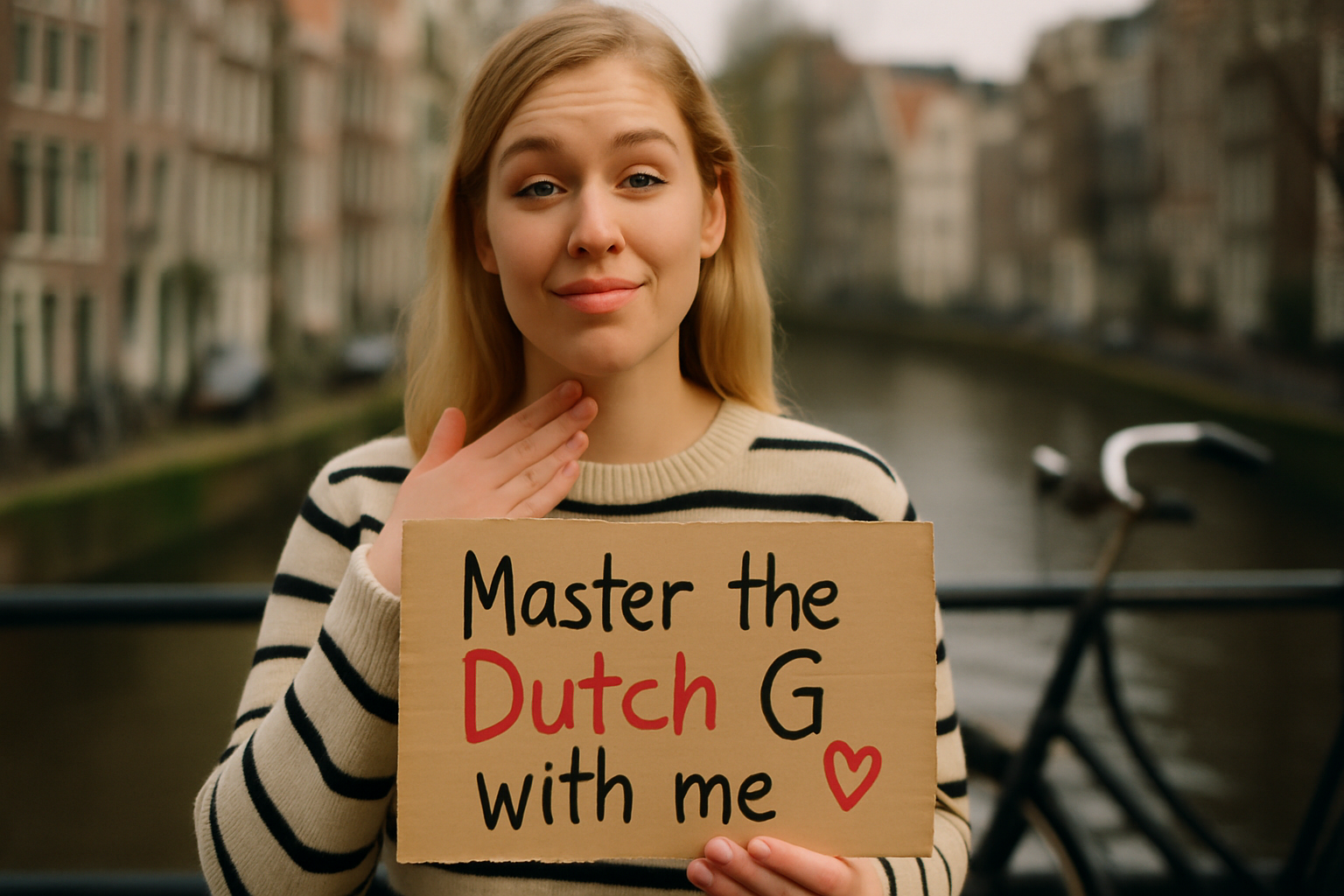
Dutch is one of the most learnable languages for English speakers — same Germanic family, similar grammar, half the words are recognizable on sight. The catch? The pronunciation. The throaty G, the long/short vowel pairs that distinguish whole words, and the sneaky IJ digraph. By the end of this page, the famously hard parts of Dutch will start to feel like home.
What you'll walk away with
- Hear every Dutch letter spoken by a native voice
- Befriend the famous Dutch G — and learn why Northern and Southern speakers pronounce it differently
- Master the long/short vowel system that distinguishes man from maan
The Dutch alphabet, one tap at a time
Every letter below is tap-to-hear. The first form is the letter; the italic name is what you say when reciting the alphabet — that's what plays when you tap. Example words are tap-to-hear in native Dutch.
- A aa — /ɑ / aː/ — appel (apple)
- B be — /b / p/ — brood (bread)
- C ce — /k / s/ — centrum (center)
- D de — /d / t/ — dag (day)
- E e — /ɛ / eː / ə/ — eend (duck)
- F ef — /f/ — fiets (bicycle)
- G ge — /x / ɣ/ — goed (good)
- H ha — /ɦ/ — huis (house)
- I i — /ɪ / iː/ — ijs (ice)
- J je — /j/ — jaar (year)
- K ka — /k/ — kat (cat)
- L el — /l/ — liefde (love)
- M em — /m/ — moeder (mother)
- N en — /n/ — nacht (night)
- O o — /ɔ / oː/ — oog (eye)
- P pe — /p/ — park (park)
- Q ku — /k/ — quiz (quiz)
- R er — /r / ʁ/ — rood (red)
- S es — /s/ — zon (sun)
- T te — /t/ — tijd (time)
- U u — /ʏ / yː/ — uur (hour)
- V ve — /v / f/ — vader (father)
- W we — /ʋ/ — water (water)
- X iks — /ks/ — taxi (taxi)
- Y ij / ypsilon — /i / j/ — yoga (yoga)
- Z zet — /z/ — zee (sea)
What every English speaker mispronounces in Dutch (and how to stop)
Six fixes that will make your Dutch sound 50% more native overnight.
- G is the Dutch signature — /x/ or /ɣ/, like German ch in Bach. Northern Dutch is harsher; Southern (Belgian/Flemish) Dutch is softer. Both are "right". Pick one and commit.
- IJ is one letter. Treated as a single character in dictionaries and crosswords. Sounds like /ɛi/ — close to English "eye". IJsland (Iceland), kijken (to look).
- EI and IJ sound identical. Spelling is the only way to tell them apart in writing — your ear can't. Both are /ɛi/.
- UI is unique to Dutch. Like saying "ow" with rounded lips. Huis (house), muis (mouse), uit (out). Don't try to map this to an English vowel; just listen and copy.
- Vowel doubling marks length. Man (man) vs maan (moon), zon (sun) vs zoon (son). The doubled vowel is held longer. This distinguishes whole words.
- Final consonants devoice like in German. Bed ends in /t/, hond (dog) ends in /t/, web ends in /p/.
Why Dutch is the secret-easy language for English speakers
Once you've befriended the throaty G and the long/short vowel game, Dutch reads with surprising regularity — and the vocabulary overlap with English means you'll be reading actual sentences in days, not months. Native audio is the fastest way to wire those vowel pairs into your ear.
Ready to turn these sounds into real conversation?
Knowing the alphabet is step zero. Sounding native is the goal. Lingden teaches Dutch through real sentences, with native audio and IPA on every word — so the sounds you just heard become words, the words become sentences, and the sentences become conversation. Free forever for one language. No card required.