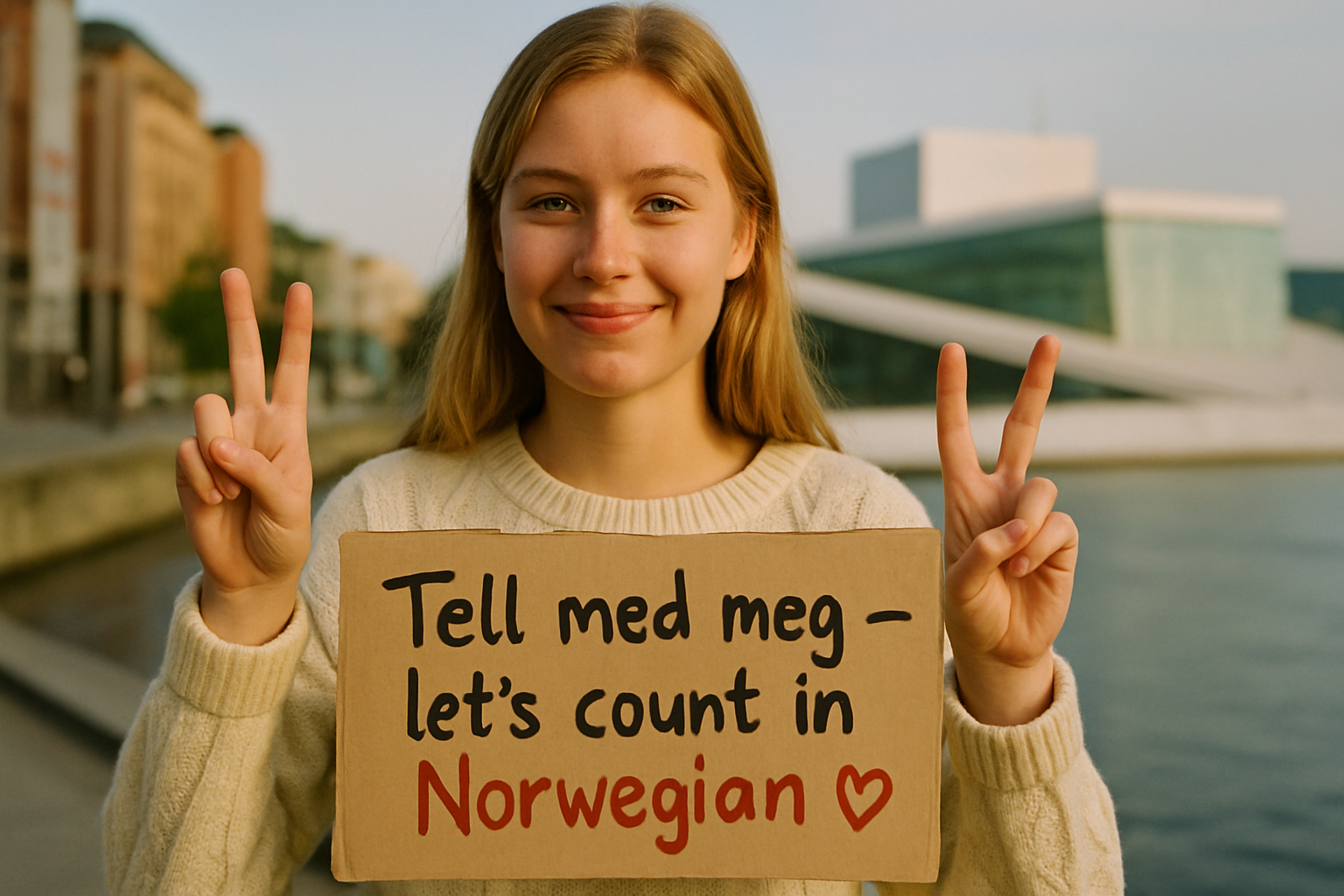
Norwegian numbers come in two flavors. The modern (post-1951) system goes forward — tjueén for 21, like English. The traditional system goes backwards like German — énogtjue. Most younger speakers use the modern form for arithmetic and the traditional for prices and dates. Both are correct and both are common; you'll need to recognize both. By the end of this page, you'll handle any Norwegian number you encounter.
What you'll walk away with
- Hear every Norwegian number from a native Bokmål voice
- Learn both the modern (forward) and traditional (backward) ways to say 21+
- Walk away able to read kroner prices, phone numbers, and years in real Norwegian
The foundational ten — 0 to 10 in Norwegian
These eleven words are the building blocks for every Norwegian number you'll ever say. Tap any to hear it spoken. Spend a minute here — the rest of the article assumes you've heard each of them.
- 0 — null
- 1 — én
- 2 — to
- 3 — tre
- 4 — fire
- 5 — fem
- 6 — seks
- 7 — sju
- 8 — åtte
- 9 — ni
- 10 — ti
11 to 20 — where Norwegian shows its character
Some of these are unique words you'll need to memorize; others follow a pattern. Tap any to hear it. Pay attention to the rhythm — the teens often have a distinctive cadence in each language.
- 11 — elleve
- 12 — tolv
- 13 — tretten
- 14 — fjorten
- 15 — femten
- 16 — seksten
- 17 — sytten
- 18 — atten
- 19 — nitten
- 20 — tjue
The tens — 20, 30, 40… up to 100
Once you know these, you can build every two-digit number using the combining rule below. Tap any to hear it.
- 20 — tjue
- 30 — tretti
- 40 — førti
- 50 — femti
- 60 — seksti
- 70 — sytti
- 80 — åtti
- 90 — nitti
- 100 — hundre
Two ways to say 21 (and both are right)
Modern (1951+): Tens then units, with a space — tjueén (21), tjueto (22), trettifem (35). This is what schools teach today and what most younger Norwegians use for math. Traditional: Unit + og + tens — énogtjue (21), toogtjue (22), femogtretti (35). This is still very common in everyday speech, especially for prices and ages. Recognize both, produce the modern. That's the standard advice from Norwegian teachers — you'll hear both, but writing in the modern form makes life easier.
Big numbers — 100, 1,000, and 1,000,000
These three words unlock everything from prices to populations to budgets. Tap any to hear it.
- 100 — hundre
- 1000 — tusen
- 1000000 — million
What every Norwegian textbook hand-waves about numbers
Six insights that get you fluent in both number systems.
- The 1951 reform was real, and it stuck only halfway. Schools teach tjueén, but at the bakery the cashier still says éntogtjue kroner. Both are valid Norwegian.
- Sju and syv both mean 7. Sju is more common in modern Norwegian; syv is older but still used in some dialects and on bus schedules. Same word, different form.
- *Én has an accent only when it specifically means "one" (vs the indefinite article en). Én bok = "one book" (emphasis on quantity). En bok* = "a book". The accent is grammatically meaningful.
- *Hundreds use og before the tens. Hundre og fem (105), to hundre og førti (240). The og* connector is required here — unlike English's optional "and".
- Norwegian uses a comma for decimals, period for thousands — continental European style. Kr 1.234,50.
- Phone numbers are read in pairs. 22 33 44 55 reads as toogtjue, treogtretti, firogførti, femogfemti — using the traditional form, often with a og.
Why Norwegian counting is more flexible than fixed
Norwegian gives you two correct ways to say every number above 20. Most learners panic at first; once you accept that both are normal, the system is one of the friendliest in any language. Stick to the modern form when you write, recognize both when you listen, and you'll never be lost at a Norwegian cash register again.
Ready to count in real conversations?
Numbers are everywhere — in prices, in addresses, in dates, in directions. Lingden teaches Norwegian through real sentences with native audio and IPA on every word, so the numbers you just learned become the words people actually use. Free forever for one language. No card required.