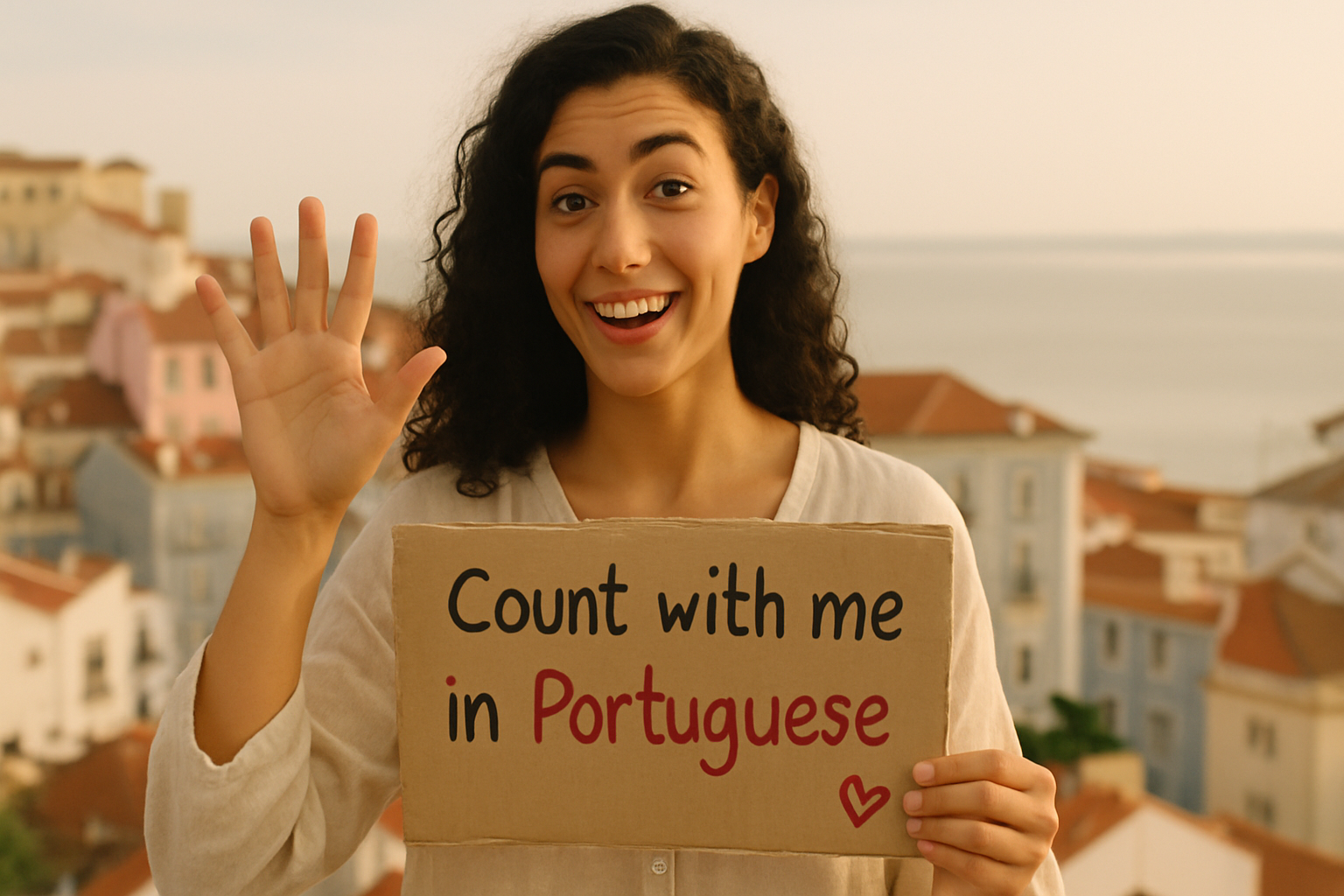
Portuguese numbers are clean, predictable, and one of the friendliest systems in any Romance language. The first ten are foundational, the teens have a clear rhythm, and the combining rule uses a simple "e" (and) between tens and units. By the end of this page, you'll count from zero to a million in Brazilian Portuguese — and you'll know the small differences from European Portuguese as you go.
What you'll walk away with
- Hear every Brazilian Portuguese number spoken by a native voice
- Master the simple e combining rule that builds every two-digit number with no exceptions
- Walk away able to read prices in reais, phone numbers, and years
The foundational ten — 0 to 10 in Portuguese
These eleven words are the building blocks for every Portuguese number you'll ever say. Tap any to hear it spoken. Spend a minute here — the rest of the article assumes you've heard each of them.
- 0 — zero
- 1 — um
- 2 — dois
- 3 — três
- 4 — quatro
- 5 — cinco
- 6 — seis
- 7 — sete
- 8 — oito
- 9 — nove
- 10 — dez
11 to 20 — where Portuguese shows its character
Some of these are unique words you'll need to memorize; others follow a pattern. Tap any to hear it. Pay attention to the rhythm — the teens often have a distinctive cadence in each language.
- 11 — onze
- 12 — doze
- 13 — treze
- 14 — catorze
- 15 — quinze
- 16 — dezesseis
- 17 — dezessete
- 18 — dezoito
- 19 — dezenove
- 20 — vinte
The tens — 20, 30, 40… up to 100
Once you know these, you can build every two-digit number using the combining rule below. Tap any to hear it.
- 20 — vinte
- 30 — trinta
- 40 — quarenta
- 50 — cinquenta
- 60 — sessenta
- 70 — setenta
- 80 — oitenta
- 90 — noventa
- 100 — cem
How to build Portuguese numbers
Combine tens and units with "e" (and): vinte e um (21), trinta e dois (32), noventa e nove (99). For hundreds, the same rule: cento e um (101), duzentos e cinquenta (250). Hundreds also use e between sub-100 components when present: duzentos e trinta e quatro (234). Notice how the e threads through every level — Portuguese loves connectors. Hundreds 200–900 each have their own word: duzentos, trezentos, quatrocentos, quinhentos (500 — irregular), seiscentos, setecentos, oitocentos, novecentos.
Big numbers — 100, 1,000, and 1,000,000
These three words unlock everything from prices to populations to budgets. Tap any to hear it.
- 100 — cem
- 1000 — mil
- 1000000 — milhão
The Portuguese number patterns that confuse everyone
Six insights that turn Portuguese counting from "almost Spanish" into its own thing.
- 100 is two words. Cem alone or before another big unit (cem mil = 100,000). Cento in compounds: cento e um (101), cento e vinte (120). Same trick as Spanish cien/ciento.
- 500 is irregular. Quinhentos (not cincocentos). Memorize this one — the others (200–400, 600–900) follow the -centos pattern. Yes, setecentos (700) and novecentos (900) are also slightly squished, but they're recognizable.
- Hundreds agree with gender. Duzentos homens (200 men) but duzentas mulheres (200 women). The masculine -os changes to feminine -as across all hundreds.
- Two and one have feminine forms. Dois / duas (2), um / uma (1). Duas mulheres, uma casa.
- Brazilian uses a comma for decimals, period for thousands — opposite of US convention. R$1.234,56 is what English writes as $1,234.56.
- Brazilian and European Portuguese diverge slightly. Dezesseis (BR) vs dezasseis (PT) for 16. Dezessete vs dezassete for 17. Same number, slightly different vowel — the meaning is identical.
Why Portuguese counting unlocks fast
Portuguese rewards consistency. Master the foundational 30 words and the e combining rule, and every two-digit number becomes automatic. The few irregularities — cem/cento, quinhentos, the gendered hundreds — are easy to internalize. By the end of one solid practice session, you'll be reading prices in supermarkets and understanding numbers in fast speech.
Ready to count in real conversations?
Numbers are everywhere — in prices, in addresses, in dates, in directions. Lingden teaches Portuguese through real sentences with native audio and IPA on every word, so the numbers you just learned become the words people actually use. Free forever for one language. No card required.