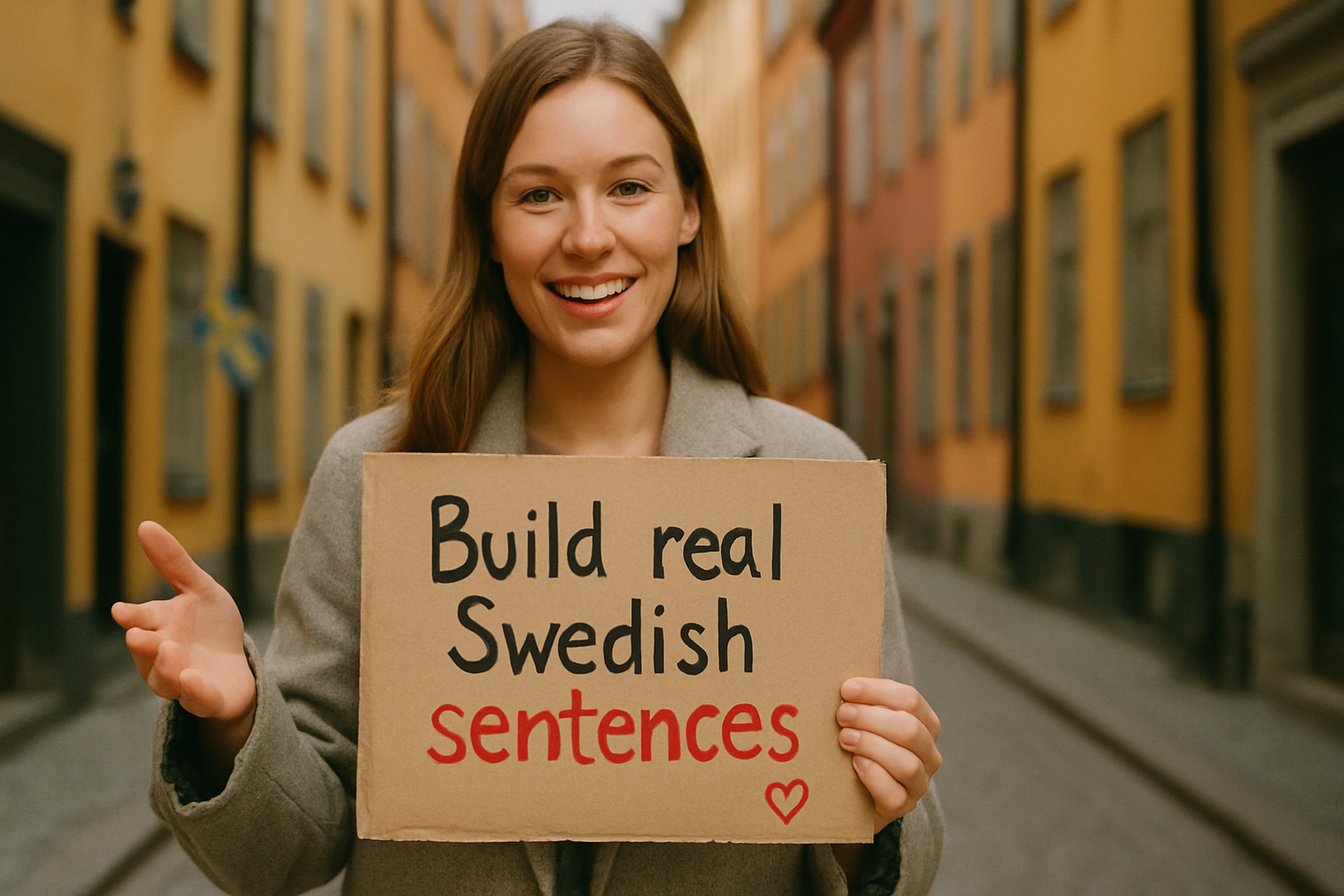
Swedish Sentence Structure — Build Your First Real Sentences
Learning to construct sentences in Swedish is a rewarding step for any language learner. With a few basic rules, you can start forming your own sentences and communicating effectively. This guide will walk you through the essentials of Swedish sentence structure so you can begin speaking with confidence.
Basic Sentence Patterns
Swedish follows a verb-second (V2) word order, meaning the verb typically comes second in a statement. This is a key difference from English, where the subject often comes first. Here’s a simple formula to remember:
- Subject + Verb + Object
For example:
- Jag läser en bok. (I read a book.)
Notice how the verb läser comes second. This rule applies even if the sentence begins with a time phrase or another element:
- Idag läser jag en bok. (Today, I read a book.)
Forming Questions
In Swedish, forming questions is straightforward. You can invert the subject and verb or use a question word. Here are two common patterns:
- Verb + Subject + Object?
- Question word + Verb + Subject + Object?
Examples include:
- Läser du en bok? (Are you reading a book?)
- Varför läser du en bok? (Why are you reading a book?)
To ask about location, you might say:
- Var är boken? (Where is the book?)
Using Negation
To make a sentence negative, use the word inte (not) after the verb. This placement is crucial to maintain the correct word order:
- Jag läser inte en bok. (I am not reading a book.)
If a sentence starts with a time phrase, the structure remains consistent:
- Idag läser inte jag en bok. (Today, I am not reading a book.)
Negation can also be applied to questions:
- Läser inte du en bok? (Aren't you reading a book?)
Common Mistake: Word Order
A frequent mistake among beginners is placing the verb incorrectly. Remember, in Swedish, the verb must be the second element in the sentence. For instance, avoid saying:
- Jag en bok läser. (Incorrect)
Instead, ensure the verb follows the subject or any initial phrase:
- Jag läser en bok. (Correct)
Another common error is omitting the verb when forming questions. Always ensure the verb is present and correctly positioned:
- Var boken? (Incorrect)
- Var är boken? (Correct)
Practice with Time Phrases
Incorporating time phrases at the beginning of your sentences is a great way to practice. Here are some examples:
- Imorgon går jag till jobbet. (Tomorrow, I am going to work.)
- På lördag träffar jag mina vänner. (On Saturday, I meet my friends.)
Time phrases can add context and depth to your sentences and help you practice the V2 rule.
How to Practice
To get comfortable with Swedish sentence structure, try these exercises:
- Write five sentences using the V2 word order.
- Convert those sentences into questions.
- Make each sentence negative using inte.
- Add a time phrase to each sentence and ensure the verb remains second.
By practicing regularly, you’ll soon find it easier to form sentences naturally. Listen to native speakers and mimic their intonation and structure.
Conclusion
Mastering Swedish sentence structure is an essential step in your language-learning journey. Remember the verb-second rule, practice forming questions, and use negation correctly. With Lingden, you can access real sentences with word audio and IPA pronunciation to further enhance your skills. Happy learning!